


A Beginner's Guide to Spotting Kingfishers on the Little Wye
The bird you are looking for is smaller than you expect. Most people picture something heron-sized and slow, and then a kingfisher goes past at knee height, a blue line over brown water, and it is over before the brain catches up. That is the usual first sighting. This guide is about turning that accident into something you can plan. It is written for the Little Wye, but the principles will work on almost any small, fast, fish-rich river in Britain.
Start with the shape, then the colour
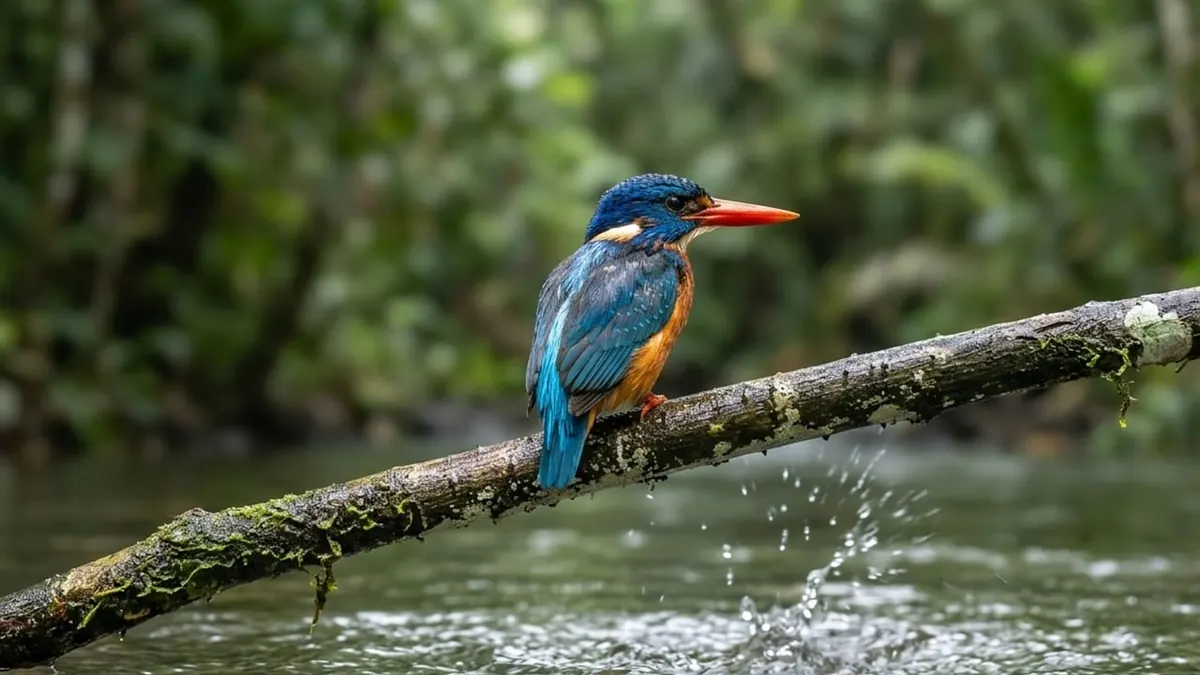
A common kingfisher is roughly sparrow-sized but built like a dart: big head, stubby tail, long dagger of a bill, body held very upright on the perch. That silhouette — compact, top-heavy, still — is what your eye should learn first. Look for a small, round-shouldered shape sitting motionless over water, often on a bare branch, a root, a fence post or a moored boat’s rope. It may sit for minutes, then drop like a stone.
The famous colour is also slightly misleading. Seen from behind, which is how you will usually see it, the back is a hard electric blue with paler turquoise speckling. That blue is structural rather than pigment, so in flat grey light the same bird can look almost black-green. The underside is burnt orange with a white throat patch. If one perches facing you in decent light, check the bill: all black is usually a male, while a female shows orange-red on the lower mandible. Juveniles are duller, greener and have a pale tip to the bill.
In flight, forget colour. Look for a low, fast, straight line just above the water, wings whirring, often ending in a short upward flick onto a branch. The flight is so direct that it can look like a small clockwork toy being pulled along a wire. If you see a blue flash and then nothing, stop and scan the bank; the bird has almost certainly perched just out of sight.
What else it could be
On a river like the Little Wye, a flash of blue can also be a grey wagtail, a mandarin duck, or even a dragonfly. Grey wagtails have a dipping, bounding flight and a long tail; they often feed on the same shallow margins. Mandarin drakes are gaudy but larger and paddle. A dipper is dark brown with a white bib and bobs on rocks. None of them fly like a kingfisher: low, level, and straight, as if shot from a bow.
The call travels further than the bird
Kingfishers are heard far more often than seen. The call is a single, very high, sharp whistle — a thin cheee, often repeated in flight, sometimes doubled. It cuts through the sound of moving water in a way a splash never does. Learn it once from a recording and you will start picking it out within a week. When you hear it, stop walking, stand still and scan along the bank in the direction of the sound. The bird is usually nearby and about to land.
It is worth practising the call in different conditions. On a still morning it carries a long way; in a gale or beside a weir it can vanish into the noise. Many people hear their first kingfisher without realising what it is, because the whistle is so high and thin that it seems to come from the air itself. Cup your hands behind your ears to boost high frequencies, or use a parabola if you have one.
The other giveaway is the dive: a small, tidy splash in the margins, rings spreading, then a bird lifting back onto a perch with something silver in its bill. Watch where it returns to. Kingfishers use the same few favourite perches all day, and often for weeks. If you find a perch with white droppings beneath it — small, chalky splashes — you have found a regular station. Return to it quietly at first light and your chances improve sharply.
When to go: a season-by-season view
Spring
March to May is the loudest, most visible stretch of the year. Pairs chase each other at speed along the river, calling constantly, and you will sometimes see two birds flying one behind the other like thrown knives. Courtship feeding — the male passing a small fish to the female — happens on exposed perches. From March, adults start excavating nest tunnels in soft vertical banks. They need bare earth, so look for small holes, often hidden by overhanging roots or vegetation. Keep well back: disturbed birds may abandon a tunnel.
Summer
Young birds appear from late spring and family groups work the shallows together. Juveniles are duller and greener, with a pale tip to the bill. But this is also when the river is busiest with people, dogs and paddlers. Adults moult after breeding, and a bird in heavy wing moult would rather sit tight than show itself. Early mornings are the answer in July and August. Be on the water before the first dog walkers, and you may catch a family party fishing in the shallows with no one else around.
Autumn
Often the best of the lot. Young birds disperse and turn up on stretches where they were not bred, so a river holding one pair in June can hold several birds by October. The water cools and clears, fish shoal in the shallows, and the light comes in low and slanted — exactly what shows the blue. This is the season for slow, quiet walks upstream, stopping every hundred metres to scan the same few perches. If you keep a note of where you see a bird in October, there is a good chance it will still be there in December.
Winter
Cold, clear mornings after a frost are excellent, provided the water is still moving. A kingfisher in winter has to catch small fish almost continuously to keep going, so it hunts all day with few breaks. When the main channel freezes or floods, birds move onto smaller, faster stretches that stay open. Go, get cold, and be patient. Wear gloves that let you use binoculars, and keep your hands out of your pockets — you will need to focus fast.
Reading the water: where they actually hunt
Find the perch and you will find the bird. Kingfishers need a clear drop into shallow water over a hard bottom, with something to sit on. On the Little Wye, concentrate on:
- Overhanging branches that dip within a metre of the surface, especially dead or leafless ones.
- Roots and exposed banks where the current has undercut the soil, leaving a natural shelf.
- Fence posts, bridge rails and sluice gates — any man-made structure with a clean view of the water.
- Islands and gravel spits where a bird can watch both sides of the channel at once.
- Back eddies and mill tails where small fish gather out of the main flow.
- Moored boats and pontoons on quieter reaches, though these birds are often more wary there.
Depth matters. Kingfishers prefer water shallow enough that a dive can reach the bottom, usually less than half a metre, but deep enough to hold small fish. They also need clear water to see prey. After heavy rain, when the river is brown and rising, they may move to side streams or sit out the flood altogether. On the Little Wye, the best conditions are a falling river that has had a day or two to clear, with a gentle flow and plenty of exposed perches.
Light is the other variable. A perch that faces east will be lit at dawn; a west-facing one catches the evening sun. If you are photographing or just want the full electric blue, put the sun behind you and the bird in front. In flat light, watch for movement instead of colour — the dive, the flick, the sudden drop.
Fieldcraft: how to get close without trying
Kingfishers are not rare, but they are easily pushed. The best approach is not to approach at all. Find a likely stretch, sit still against a bank or tree, and let the river come back to normal. It usually takes ten to fifteen minutes for the birds to forget you are there. Wear dull clothing, keep your silhouette broken, and avoid sudden movements. Binoculars are essential; a scope is useful on wide, open reaches but a burden on narrow, overgrown ones.
Walk slowly and stop often. Kingfishers often reveal themselves by calling as they fly past, so your ears are doing half the work. If you do flush a bird, do not follow it. Note the direction, wait, and move on quietly. It will usually return to the same perch within a few minutes if you stay put and keep low.
Tip: the best view is often not the closest one. A bird sitting naturally on its perch at twenty metres is worth more than a blurred panic at five.
What to carry on the Little Wye
- Binoculars — 8x32 or 8x42 are ideal for close, fast birds in woodland light.
- A notebook or phone notes — record time, weather, water level and perch location.
- Polarised sunglasses — they cut glare and help you see fish and submerged perches.
- Warm, quiet clothing — no rustling waterproofs if you can help it.
- A flask — patience is easier when you are warm.
Leave the drone, the playback and the dog at home. Playing a recording to lure a kingfisher is illegal in the UK if it disturbs a protected bird at or near a nest, and it is bad practice anywhere. Keep your distance from nest banks, and never block a bird’s flight line along the river.
A simple practice routine for your first month
- Pick one short stretch of the Little Wye — no more than half a kilometre — and walk it at least twice a week.
- Learn the kingfisher call from a field guide or app before you go. Listen for the thin cheee above the water noise.
- Choose three or four perches to check every visit. Sit quietly for ten minutes at each, even if you see nothing.
- Note the water level and light direction each time. Patterns will emerge quickly.
- After a month, you will know which perches are regular and which are occasional. That is when kingfisher watching stops being luck and starts being a skill.
The Little Wye is small enough that you can learn it properly. One day you will hear the whistle, see the blue line, and know exactly where it is going to land. That is the moment this guide is trying to give you.